
Orthopedic SEO Checklist | Service Pages, Profiles and Listings
An orthopedic SEO checklist is a practical list of the work that helps an orthopedic practice's website and listings show up when people search for joint, spine, sports injury and fracture care in their area. It covers the pages on the site, the practice's local listings and the technical health of the website.
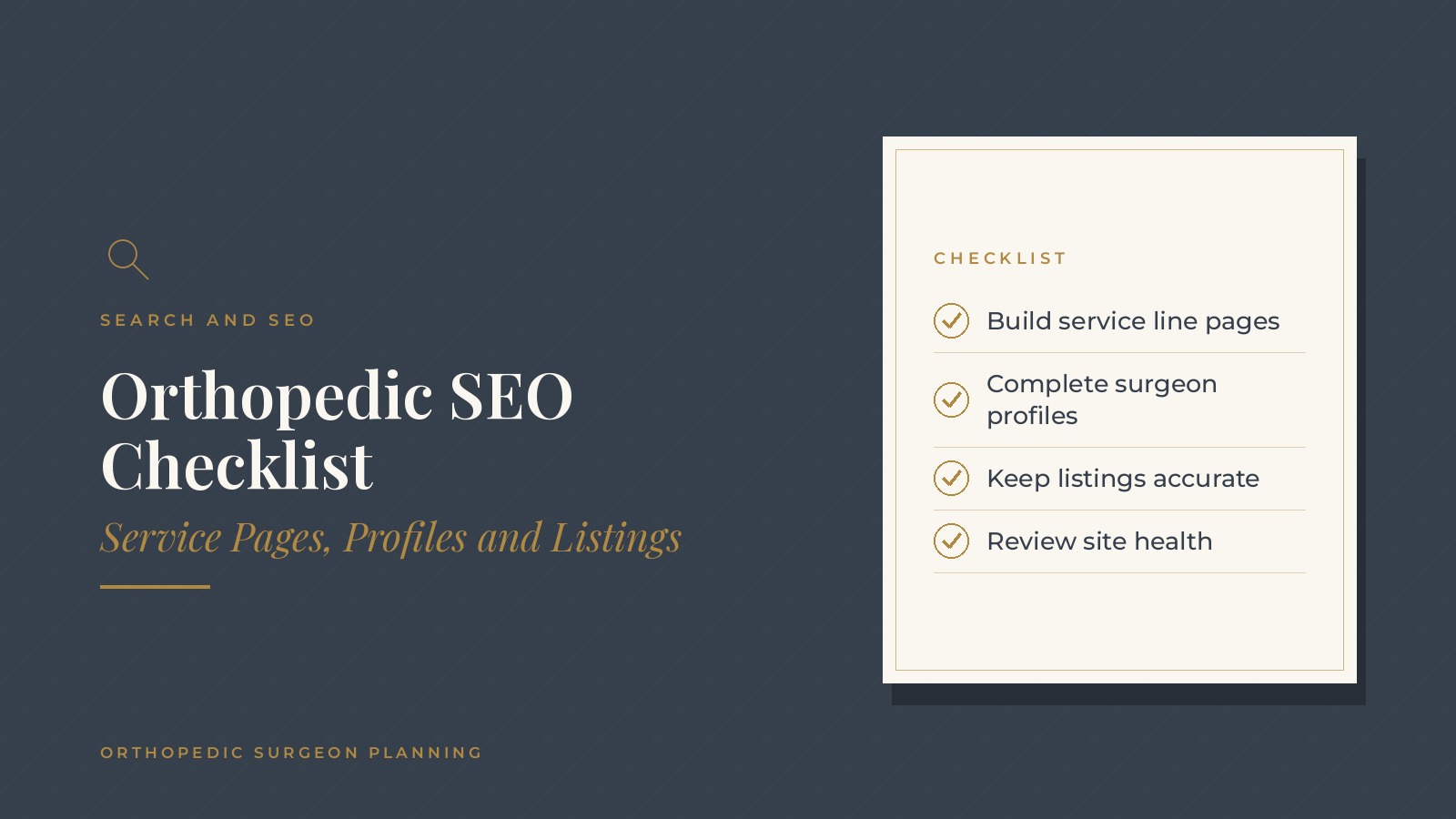
In short, this checklist tends to work best when the site has clear pages for each service line and common condition, every surgeon has a complete profile, each office has accurate listings, the site loads quickly and stays easy to crawl, and progress is reviewed on a steady monthly rhythm.
This checklist from Orthopedic Surgeon Planning explains how orthopedic searches work, service line pages, surgeon profiles, local search, site health, content planning, reporting and the questions practices often bring to an SEO professional.
Key takeaways
- People search by problem, body part and place.
- Build clear pages for each service line.
- Give every surgeon a complete profile.
- Keep every office listing accurate.
- Review site health and results each month.
How an orthopedic SEO checklist starts with search
Searches start with a problem
Many people search for a symptom or injury, such as knee pain on stairs or a broken wrist, before they ever search for a practice or surgeon name.
Location shapes the results
Searches that include near me or a city name lean heavily on local signals, such as the practice's business profile, address and the distance to each office.
Different stages of the search
Some searches are early research, while others, such as a hip replacement surgeon in a named city, come from people closer to booking. A strong site has pages for both.
AI answers join the results
AI assistants and AI summaries in search now answer many early questions. Clear, well organized pages with accurate practice details give these tools reliable material to draw from.
Service line pages
One page per service line
Joint replacement, spine, sports medicine, hand and upper extremity, and foot and ankle care each deserve their own page that explains the care offered and who provides it.
Condition and procedure pages below
Under each service line, pages for common conditions and procedures answer the specific questions people search, written in plain language and reviewed by a physician.
Clear links between pages
Linking each condition page to its service line, and each service line to the related surgeons and locations, helps visitors and search engines follow the structure.
The orthopedic condition pages guide covers how condition pages under each service line are usually written and reviewed.
Orthopedic Surgeon Planning can introduce you to independent SEO professionals who work with orthopedic practices on search visibility, service line pages and local search. To request an introduction, contact us or call or text (972) 616-4581. You can also read about SEO for orthopedic practices.
Surgeon profiles
More than a name and title
A complete profile lists the surgeon's training, the service lines and conditions they focus on, the offices where they see patients and a short personal introduction.
Linked to the right pages
Profiles that link to the service lines each surgeon practices, and service pages that link back, connect people to the right surgeon faster.
Consistent everywhere
The surgeon's name, credentials and office locations should read the same on the website, business listings and health directories.
Clinicians beyond surgeons
Physician assistants, nurse practitioners and non-operative physicians who see patients can have profiles too, which helps people find the right first visit.
Local search for each office
A business profile per location
Each office usually has its own Google Business Profile with accurate hours, phone number, services and categories that fit orthopedic care.
A location page per office
A page on the website for each office, with the address, directions, hours, parking notes and the surgeons who see patients there, supports the listing.
Steady listing upkeep
Holiday hours, a new surgeon or a changed phone number all call for updates across listings and directories so the details stay matched.
The orthopedic multi-location SEO guide explains how practices with several offices often organize listings and location pages.
Site health and technical basics
Speed on phones
Many orthopedic searches happen on a phone, sometimes right after an injury. Pages that load quickly and read easily on small screens keep people from leaving.
Crawlable structure
Clean page addresses, a current sitemap, working internal links and no duplicate pages make it easier for search engines to find and understand the site.
Structured data
Markup for the practice, locations, physicians and FAQs helps search engines and AI tools read key details correctly.
The orthopedic schema markup guide looks at the structured data types many orthopedic sites use.
Fixing broken pages
Regular checks for broken links, missing pages and redirects left over from past redesigns keep visitors and search engines from hitting dead ends.
Content planning and reporting
A steady content plan
Articles that answer common questions about recovery planning, imaging visits or choosing between care options support the service pages and give people reasons to return.
Reports that fit the practice
Monthly reports often cover search visibility for key service lines, visits to important pages, calls and appointment requests from search, and listing activity by office.
Patience with the timeline
Search visibility usually builds over months rather than weeks, so many practices judge progress by steady trends instead of single week changes.
Keeping older pages fresh
Reviewing older articles and condition pages once or twice a year, updating details and links, keeps the site accurate without starting over.
Questions practices bring to an SEO professional
Planning questions
Practices often ask which service lines to start with, how many condition pages make sense and how surgeon profiles should be structured.
Process questions
Other topics include how physician review of clinical wording fits the schedule, how listings are managed across offices and how site changes are tested.
Measurement questions
An SEO professional can explain which reports matter most for an orthopedic practice, how calls and requests are tracked and how often the plan is revisited.
Working with the team
Many practices name one staff contact who gathers physician reviews, shares office updates and passes along new service lines, which keeps the work moving.
Frequently asked questions
What is an orthopedic SEO checklist?
It is a practical list of the work that helps an orthopedic practice's website and listings appear when people search for joint, spine, sports injury and fracture care.
What pages does an orthopedic website need for SEO?
Common pages include one per service line, pages for common conditions and procedures, a profile for each surgeon and a page for each office.
How does local search fit into orthopedic SEO?
Each office usually has an accurate business profile and a matching location page, with hours, phone numbers and surgeons kept up to date.
How long does orthopedic SEO take to show progress?
Search visibility usually builds over several months, so many practices look at steady monthly trends instead of week to week changes.
How do orthopedic practices measure SEO?
Many track visibility for key service lines, page visits, calls and appointment requests from search, and listing activity for each office.
Request an introduction
Orthopedic Surgeon Planning can introduce you to independent SEO professionals who work with orthopedic practices on orthopedic SEO planning, service line pages and local search listings. Learn more about SEO for orthopedic practices, then take the short Orthopedic Surgeon Planning Marketing & SEO survey and request an introduction. You can also call or text (972) 616-4581, or contact us. The form goes to [email protected].